The Problem
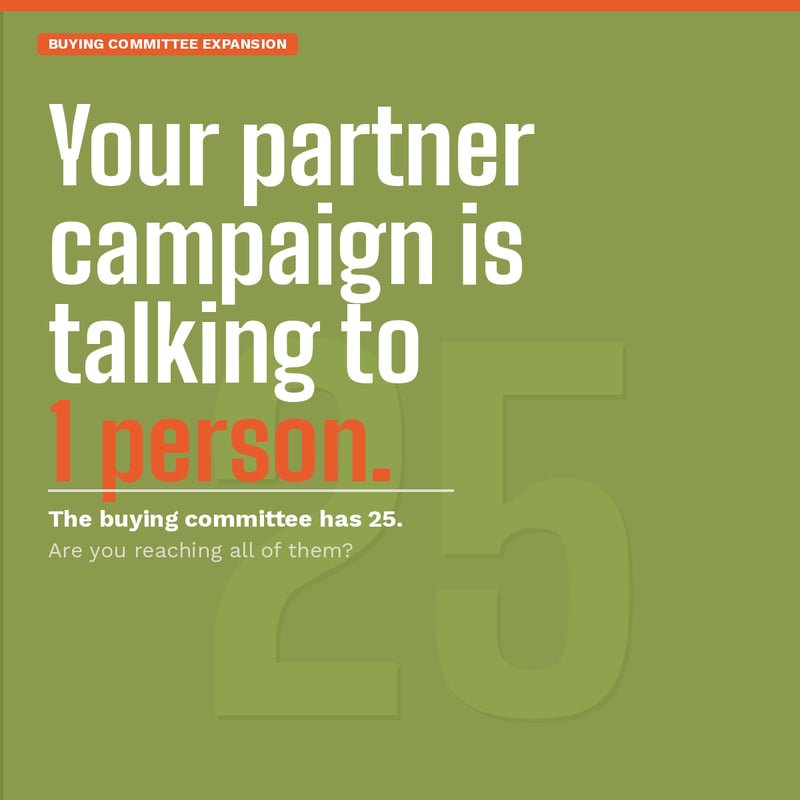
Here is a number worth sitting with: the average technology buying committee now includes 25 people. In enterprise organisations, that figure climbs to 33. And yet most partner-enabled campaigns are still built around a single persona, the IT lead, with maybe one additional stakeholder mapped in for good measure.
The result is predictable. Vendors invest in partner marketing that reaches a fraction of the people who will actually influence the deal. Buying happens anyway, but not with you in the room for most of it.
|
25 |
Average number of people in a technology buying committee (Foundry, 2023) |
|
33 |
Average buying committee size in enterprise organisations |
|
38% |
Of buying committees now include the CEO, up significantly as tech spend becomes strategic |
Why This Is Getting Worse
Buying committees have not just grown in size; they have changed in composition. C-suite involvement is no longer the exception. According to Madison Logic research, 38% of buying committees now include the CEO, and purchasing decisions are increasingly being overruled at senior level: 58% of buyers report that a decision they were leading was reversed or escalated by a more senior executive.
This is not a coincidence. As technology investment has shifted from operational tooling to strategic infrastructure, AI, data platforms, security, the business case has moved upward. The CIO or IT lead no longer signs off alone. The CFO wants to see ROI modelling. The CEO wants to understand strategic alignment. The CPO wants to know what implementation looks like on the ground.
Meanwhile, partners are still being briefed, enabled, and measured as if the buying journey is a two-person conversation.
The Gap That Intent Data Closes
The challenge for most vendors is not understanding that buying committees have expanded; it is knowing who is in the room at any given account, at any given time, and which roles are actively engaging with the category right now.
This is where intent data changes the equation. Rather than mapping buying groups theoretically, intent signals allow vendors and their partners to see which roles at target accounts are actively consuming content related to their solution category. Who is researching. Who is comparing. Who entered the conversation three weeks before the RFP landed in a rep's inbox.
|
83% |
Of IT decision-makers download an average of 6 pieces of content per purchase cycle (Foundry) |
|
94% |
Of tech buyers watch video content for business purposes — most of it consumed outside vendor channels |
That content consumption is a signal. And when it is mapped to specific roles within a target account; not just the primary IT contact but the CFO who started reading about cost benchmarking, the CISO who downloaded a compliance brief, the COO who attended a webinar on operational efficiency, the picture of the buying group becomes specific, actionable, and early.
What This Means for Partner Enablement
For vendors running partner programmes, the implication is direct. If partners are only activated for the IT lead, they are entering the deal at one node of a 25-person network. Every other node is either being influenced by a competitor, making decisions in a vacuum, or both.
The most effective partner marketing programmes being run today share a common characteristic: they equip partners to engage the full buying group, not just the primary contact. That means:
- Content mapped to C-suite priorities: ROI for the CFO, strategic alignment for the CEO, security and scalability for the CIO
- Intent signals delivered to partners so they know which roles at target accounts are active right now
- Outreach that does not rely on partners having pre-existing relationships at every level
- Campaign structures that can reach the buying group across multiple channels; not just email to the IT contact
How S2W Media Approaches This
At S2W Media, buying committee mapping is not a theoretical exercise. Our Partner-Pipeline-as-a-Service model uses first-party intent data to identify which accounts in a partner's territory have active buying signals across multiple roles and then builds campaign execution around engaging those roles with the right content at the right stage of the journey.
Vendors do not have to rely on partners to have the right contacts. We identify the contacts, validate the intent signals, and build the outreach, so partners can focus on what they do best: the conversations that close.
Talk to S2W Media about mapping the full buying committee at your target accounts


